
Objective
Transforming wastewater into opportunity through solar-powered plasma innovation.
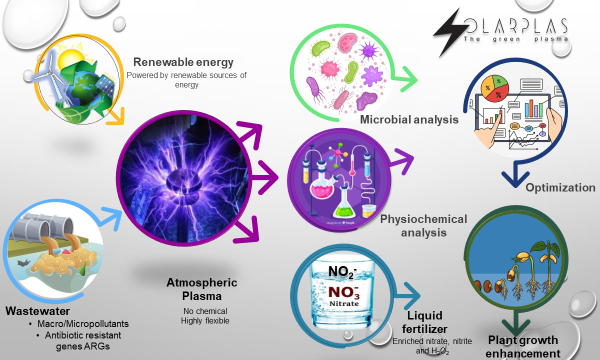
SolarPlas (Project No. 101106614) is a MSCA Global Fellowship dedicated to developing a solar-powered atmospheric plasma system that treats contaminated wastewater efficiently — without chemicals, fossil fuels, or harmful byproducts.
Funded by the European Commission (EU) under Horizon Europe, the project promotes international collaboration and knowledge exchange between:
University of Padova, Italy (Return Host)
NED University of Engineering & Technology, Pakistan (Outgoing Phase)
Fellow: Dr. Mubashir Saleem
This system merges plasma science, renewable energy, and advanced water engineering to produce portable, modular, and eco-friendly wastewater treatment units for communities worldwide.
Atmospheric plasma technology offers a chemical-free, energy-optimized alternative to conventional treatment methods, with unique advantages:
- Destroys a wide range of contaminants — including pharmaceuticals, hormones, microplastics, and antibiotic resistance genes — without producing secondary pollution.
- Operates at ambient temperature and pressure, eliminating the need for high-pressure vessels or heating systems.
- No added chemicals, avoiding cost, handling hazards, and residual by-products.
- Fast reaction times — pollutant breakdown occurs within seconds to minutes.
- Easily powered by renewable energy, enabling deployment in off-grid or low-resource settings.
- Scalable and modular, suitable for both small point-of-use units and large centralized systems.
The United Nations World Water Development Reports highlight the urgent need for innovation in water treatment:
- Wastewater treatment can account for up to 60% of a city's total energy use [1].
- Emerging contaminants (ECs) — pharmaceuticals, hormones, microplastics — are increasingly found in drinking water sources [2].
- Asia and Europe face the highest risks of EC exposure due to heavy pharmaceutical and industrial use [3].
- Hospital wastewater (HWW) and landfill leachate (LFL) contain high loads of pharmaceuticals, antibiotic resistance genes (ARGs), and toxic organic micropollutants [4].
- A future where every drop is valued and wastewater becomes a resource rather than waste.
- Households and communities treat their own wastewater at the point of generation.
- Resource recovery is woven into daily life through a circular economy approach.
- Universal access to clean water through decentralized, sustainable treatment systems.
- Elimination of emerging contaminants and harmful pathogens from water sources.
- Integration of renewable energy with water treatment for climate-resilient solutions.
To transform wastewater from a burden into a resource through innovative, solar-powered atmospheric plasma technology that:
- Harnesses renewable energy to treat contaminated water without chemicals.
- Enables decentralized, point-of-use treatment for communities, households, and disaster-affected areas.
- Eliminates emerging contaminants and harmful pathogens to protect human health and ecosystems.
- Supports the global transition to a sustainable, climate-resilient, and circular water economy.
- Limited removal of recalcitrant contaminants such as pharmaceuticals and microplastics.
- Micropollutants can partition into biomass, complicating sludge management and increasing treatment scope.
- Large footprint and high maintenance needs limit suitability for decentralized applications.
- High energy demand and reliance on costly chemical additives.
- Residual chemical byproducts can persist in the effluent, requiring further treatment.
- Complex operation and safety requirements for chemical handling.
Atmospheric plasma treatment overcomes these drawbacks by:
- Eliminating the need for added chemicals, avoiding secondary pollution.
- Breaking down pollutants at the molecular level, ensuring complete mineralization rather than transferring contaminants into another phase (e.g., sludge).
- Generating powerful oxidizing species in situ, reducing treatment times.
- Operating effectively at ambient temperature and pressure, minimizing infrastructure and maintenance needs.
- Integrating with renewable energy sources such as solar power, making it suitable for off-grid and low-resource settings.
We are designing and building a pilot-scale solar-powered atmospheric plasma reactor to treat HWW and LFL with:
- 100% renewable energy — powered by solar photovoltaics.
- No chemical additives — avoiding secondary pollution.
- High removal efficiency — effective against ECs, ARGs, and pathogens.
- Modular and portable design — ideal for urban utilities, rural villages, and disaster response.
Applications include:
- Urban Utilities: Lower operational costs and meet stricter regulations.
- Remote Communities: Provide off-grid clean water treatment.
- Emergency Relief: Rapid deployment in disaster-hit areas.
SolarPlas directly supports climate action, public health, and economic resilience:
- Climate Change: Reduces greenhouse gas emissions by eliminating fossil-fuel-driven treatment.
- Public Health: Removes dangerous pollutants and ARGs from wastewater.
- Economic Sustainability: Cuts costs by minimizing energy and chemical use.
- Social Impact: Brings safe water treatment to underserved communities.
SolarPlas contributes to multiple UN Sustainable Development Goals:
- SDG 6: Clean Water and Sanitation
- SDG 7: Affordable and Clean Energy
- SDG 13: Climate Action
- SDG 3: Good Health and Well-being
Our vision is a world where wastewater treatment runs on sunlight, no community is left behind, and pollution is transformed into opportunity.